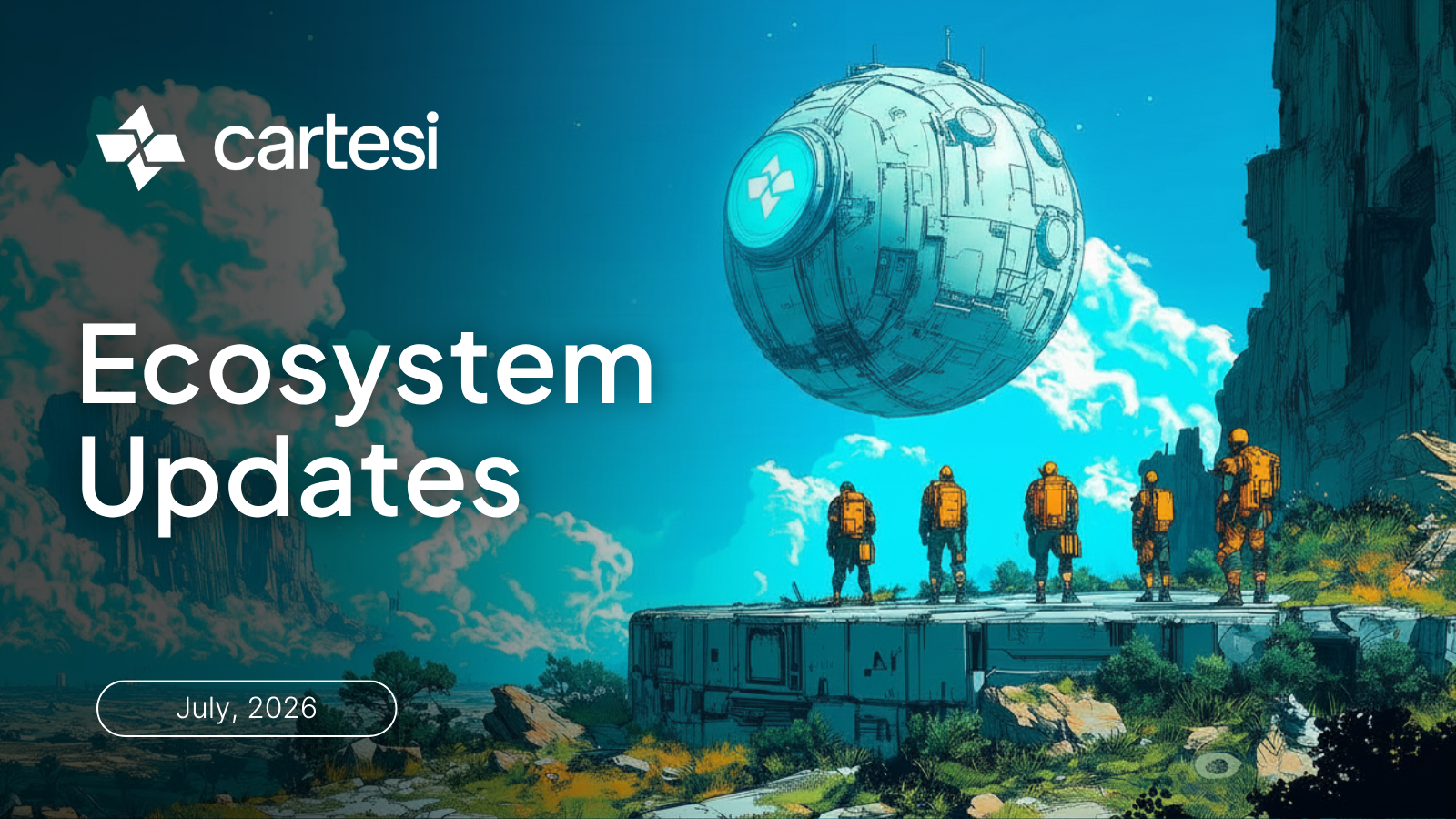
Cartesi Ecosystem Updates, July 2026. Illustrated banner of five explorers in orange spacesuits standing on a rocky platform, looking up at a large spherical mechanical structure with the Cartesi logo, set against a blue mountainous landscape.

Cartesi Ecosystem Updates - July 2026

Newsletter/Aug 7, 2026/Marketing Unit
Share:

July packed in a lot. Real progress landed on several of the architecture components and the fraud proof system, our developer advocates kept testing and spreading the word on podcasts and Spaces, and the penguin mascot showed up everywhere, from Malaysia Blockchain Week to Ethereum's birthday.

Here's your full roundup of what happened across the Cartesi ecosystem this past month.

Tech

On the tech side, this month's headlines were advancements to several components strengthening the fraud proof system, following the emergency withdrawal mechanism that shipped previously.

Rollups Contracts support for deposit refunds is in progress: work is underway to add deposit refunds for foreclosed applications, enabling the system to distinguish between finalized and non-finalized deposit inputs and route refunds accordingly. The proposal also modularizes refund output building into a dedicated contract, simplifies input box handling, and introduces interface improvements to streamline deployment and contract integration.

The fraud proof system, our Permissionless Refereed Tournament (PRT), advanced with work on claim staging, adding a safety window before tournament results are finalized. This gives independent sentries time to verify tournament results before claims are finalized, while still allowing fast settlement when all sentries agree. The change strengthens the security of the fraud-proof protocol while preserving fast settlement in the common case.

On the developer experience side, Cartesi’s TypeScript tooling has been reorganized to make integrations clearer and easier to maintain. The Rollups Node API client now ships as @cartesi/client, while the React bindings have been renamed to @cartesi/react, accompanied by a new shared codec package for encoding and decoding Rollups data.

Alongside the package reorganization, the releases align types with the latest Rollups Node API schema, improve query handling, and streamline how developers build applications that interact with both the Rollups Node API and Rollups smart contracts.

For a bird's-eye view, current architecture priorities are tracked and periodically updated on our Technical Evolution Plan (TEP) website page, so that's your go-to source to know where the technical teams are spending their time and effort.

Developer Advocacy

This past month, our developer advocates have been testing components of the architecture and feeding their feedback straight into what ships next, all in service of the same goal: lowering the barrier to building onchain with Cartesi and expanding what's possible on this compute layer for production-ready DeFi products.

That goal is also why Developer Advocacy Lead João Garcia's three-part series, "Three Levels Deep," is worth a watch if you missed it. Each episode breaks down a different Cartesi concept at three levels of depth: simple enough for a child, detailed enough for an engineering student, and rigorous enough for a PhD researcher.

So far the series has covered Cartesi's execution environment, app-specific rollups, and DeFi financial modeling. Explaining each concept three ways means builders and researchers get an entry point wherever they're starting from.

Catch the full series on X and YouTube, then head to docs.cartesi.io to start building. And as contributor Claudio Silva puts it, that means "no tension in the neck" because it's a stack you already know.

Ecosystem

In July, fellow Cartesian Felipe Argento was busy, publishing three articles. For anyone who missed the context, he previously stepped down from the Foundation Board to build the product that makes Cartesi click. He put it plainly on X: nobody is going to grasp what this stack makes possible from a diagram. They'll understand it through a product that's actually great. Read his thread.

A huge TVL sitting exposed to hacks is a problem. One party holding the power to walk off with it is another. In his latest piece, Felipe breaks down why Cartesi's Emergency Withdrawal mechanism solves both, and why it beats a security council model.

And here's why it's important, as a tl;dr:

Decentralization alone doesn't attract users or institutions. What moves things forward is fast, unapologetic, centralized actors building on top of decentralized infrastructure. Applied to Cartesi: the tech stack stays decentralized, but growth comes from intentional builders at the edges, each with their own reasons, collectively strengthening the shared infra.

Crypto's real-world impact has mostly come from pressuring TradFi to improve, not from decentralizing finance itself. That's not enough. Without real decentralization and accessibility, crypto loses its edge. The fix: apps that feel like TradFi but run decentralized under the hood, exactly what Cartesi's appchain rollups enable.

In a nutshell, said in a more marketable way: DeFi needs Cartesi.

And implicitly, that's basically a shoutout to Linux onchain:

Community

On the community front, July brought us two big events. The obvious one: the World Cup final, where Spain became world champion, and we had plenty of happy contributors cheering. But the one that matters most to us: Ethereum's 11th birthday. Both times, our penguin celebrated cheerfully.

See for yourself the tribute paid to Ethereum. We're proud to keep building in this ecosystem, complementing Ethereum with more compute power and more design space while building on the security and decentralization it provides:

And what's more, we even got to mint CTSI on the infinite pixel canvas started by Ethlabs for the occasion. Check it out here.

This month also saw everyone gathering in Kuala Lumpur for Malaysia Blockchain Week, a two-day event connecting Southeast Asia's Web3 builders, investors, and projects. Our contributor Cynthia Gliga was on the ground, and shared a quick clip touring the venue:

Media

On the media front, Developer Advocate Shaheen Ahmed responded to Dar Blockchain's invitation and joined their X Space to unpack why battle-tested software could prevent many of the exploits we're seeing, what it's like to build onchain with a Linux execution layer, and how DeFi could benefit from what Cartesi has to offer.

Catch up on the recording, or read the full recap by host Youssef Seghaier:

And Dev Advocacy Lead João Garcia continued to make headlines with the podcast Web3 CMO Stories, hosted by Joeri Billast. Make sure to watch the full episode on YouTube, but in the meantime, here's a throwback to one meaningful clip on why Linux onchain matters:

Cartesi also joined TikTok this month. The channel is live and content is dropping regularly. Hit follow, and ask your TikToker frens to do the same to help us grow.

Cartesi's CoinMarketCap community keeps expanding, and this month we’re celebrating having crossed 90,000 followers. The platform also periodically generates AI-powered articles covering our updates, breaking down what it means to build with Linux onchain, backed by Ethereum's security. Follow our profile to be part of it.

Another place we're showing up: our tech updates also receive a monthly spotlight in L2BEAT's recap, more eyeballs on a respected outlet. Read this month's article here and browse previous editions to catch up on everything.

And if you haven't already, hit subscribe on the Cartesi YouTube channel. Shorts, demos, and new tutorials drop there constantly.

As tradition goes, these ecosystem updates also get included in the Cartesians' monthly newsletter, and once again, the fastest reader is rewarded with another merch pack. Subscribe if you haven't already, and keep an eye out for the drop.

That’s a Wrap

This was July: quiet wins on the architecture, loud wins across podcasts, Spaces, and the world stage, with a community penguin that never sat still.

Now, Cartesi enters August with the foundation in place, working hard toward the same mission: becoming the verifiable compute layer DeFi has been waiting for. DeFi is the floor, not the ceiling, as co-founder Erick de Moura has put it. We look forward to also covering what's getting built on that floor over the next few months.

As always, for live updates, join us on Discord, make sure you're following us on X, and come chat and hang out with the community on Telegram.

More must-see content pieces:

Ecosystem Updates - Cartesi | L2BEAT
Two freedoms, one stack | Co-founder Erick de Moura

Off-chain processing, onchain guarantees, lower gas | DevAdvocacy Lead João Garcia on Hot Takes and Cold Wallets: Episode #28 by ChainPatrol
DeFi Needs Cartesi | Contributor Cynthia Gliga

The Institutions Are Coming | Contributor Felipe Argento

Divergence is additive, if the shared layer stays neutral | Contributor Cynthia Gliga

The emergency withdrawal is a better guardian | Contributor Felipe Argento

TL;DR on: The emergency withdrawal is a better guardian | Guilherme Dantas

Smuggling the Properties Back In | Contributor Felipe Argento

On the ground at Malaysia Blockchain Week | Contributor Cynthia Gliga

What if DeFi was built for finance first? | Joeri Billast - Web3CMO Stories Podcast

The hidden costs of building DeFi on the EVM | DevAdvocacy Lead João Garcia on Web3CMO Stories Podcast

Why Linux onchain matters | DevAdvocacy Lead João Garcia on Web3CMO Stories Podcast

Cartesi Merch Unboxing | Community Member Kamaloka3

Why DeFi Keeps Breaking | Dev Advocate Shaheen Ahmed on Dar Blockchain X Space

Why DeFi Keeps Breaking | Host Youssef Seghaier’s X Space Thread Recap

Happy Birthday Ethereum

CTSI minted on Ethereum

Cartesi Releases | Cartesi GitHub

Cartesi Builder Resources | Mugen Builders GitHub

What Is Cartesi (CTSI) | CoinMarketCap AI-powered feature

Latest Cartesi (CTSI) News Update | CoinMarketCap AI-powered feature

Subscribe to The Cartesi Newsletter

Join our newsletter to stay up to date on features and releases

More from Newsletter

Newsletter/Jul 3, 2026

Cartesi Ecosystem Updates - June 2026

June answered one of the biggest questions on the road to production: what happens when an application stops and users need to recover their funds? Emergency withdrawals are now live and being tested, alongside continued improvements across the Rollups stack and developer tooling. Beyond the technology, the month's clearest signal came from the ecosystem itself, as two Cartesi Foundation board members stepped down to build full time on the stack, reinforcing growing conviction that the future of onchain finance will be built with verifiable compute.

Written By Marketing Unit

Newsletter/Jun 5, 2026

Cartesi Ecosystem Updates - May 2026

May was a month of convergence across the Cartesi stack. Fraud-proof infrastructure and rollup contracts continued their coordinated march toward production, while contributors shipped agentic development tooling that fundamentally changes how AI tools interact with Cartesi. On the community and media fronts, the signal is growing and the DeFi space is starting to see what Linux onchain actually makes possible.

Written By Marketing Unit

Newsletter/May 1, 2026

Cartesi Ecosystem Updates - April 2026

April pushed Cartesi forward across the stack, with major engineering upgrades and a continued focus on making DeFi more accessible to builders. From Machine Emulator v0.20.0 introducing zk-proof support to ongoing improvements in Rollups, the fraud-proof system, and developer tooling, the path toward production-ready infrastructure became clearer. At the same time, practical resources and demos reinforced how easy it is to build with familiar tools, while growing ecosystem awareness supported broader adoption.

Written By Marketing Unit

© 2026 The Cartesi Foundation. All rights reserved.