
Cyberpunk-style digital illustration of a person wearing VR goggles looking at a glowing circular interface displaying DeFi applications, execution environments, and computation driven design text.

Why DeFi Needs a Better Execution Environment

Use Cases/Feb 3, 2026/João Garcia
Share:

DeFi has proven that open financial systems can exist without centralized intermediaries. We have on-chain exchanges, lending markets, derivatives, stablecoins, and entire financial ecosystems running in smart contracts. From the outside, it looks like rapid financial innovation.

But under the surface, most DeFi protocols share a hidden constraint: they are designed around blockchains limitations, not around what finance actually needs.

Today there are two approaches

1 - DeFi apps are underdelivering financial theory and being designed with execution limits in mind. Smart contracts must minimize computation, avoid complex math, pricing models are simplified, risk systems are coarse or static, market mechanisms are chosen for gas efficiency, not because it is optimal (numerically speaking).

2 - To bypass the barriers in the first approach, everything happens in centralized fashion. Users won’t know the algorithms, how and where it runs. Users have to trust people with their decisions, money or information. It’s not real DeFi.

This is not because developers lack ideas. It is because the dominant execution environments make many financial models impractical to run in a verifiable way.

In traditional finance risk engines run simulations across thousands of scenarios, portfolio systems rely on statistical models, pricing often depends on iterative methods. Engineers use mature libraries like NumPy, Pandas, SciPy, and QuantLib for these.

In DeFi, that toolbox largely disappears. Environments limit that, and it can become really expensive when available.

The result is a design space where financial mechanisms are simplified to fit the machine, instead of machines being built to fit financial logic.

This article explores what changes when that constraint is lifted. We will look at why DeFi has been technically limited, what kinds of financial systems become possible with more expressive execution environments, and how this shift enables a new class of on-chain applications: risk engines, prediction markets and more.

In short, this is about moving DeFi from gas-optimized finance to computation-driven finance.

1. The Technical Limits of Today’s DeFi Execution

Modern DeFi runs primarily on environments that were never designed to be general-purpose financial computing platforms. They were optimized for deterministic execution, strong security guarantees, and resource constraints not for statistical modeling, simulations, or complex financial logic.

On one hand, it made decentralized systems possible, but on the other they also quietly restrict financial mechanisms and define which ones are practical on-chain. Computation is expensive, so finance becomes simple.

1.1 The Absence of Native Floating-Point Math

Finance is inherently numerical. Interest rates, volatility, correlations, and pricing models all rely on continuous values and strong decimal precision.

However, many smart contract environments do not support floating-point operations. This introduces a couple issues for developers, and as a consequence to users. Additional complexity in implementation and higher risk of precision errors.

Advanced financial techniques often rely on iterative algorithms, matrix operations, and statistical calculations that assume floating-point math. Recreating these while constrained by tools increases both execution cost and development overhead which brings us to the next point...

1.2 Limited Access to Established Libraries

In traditional financial engineering and data science, developers don’t have to spend time implementing core mathematical tools from scratch. They build on top of their favourite, tried and tested tools:

  • Numerical computing libraries
  • Statistical toolkits
  • Optimization frameworks

These tools were created through decades of research and engineering practice to bring developer linear algebra, statistical modeling, simulation frameworks and more.

This leads to a gap between what quantitative finance can model and what on-chain systems can feasibly execute. App ideas have to be translated into drastically simplified forms to fit within the available execution environment.

1.3 Statefulness and Complex Logic Are Hard to Sustain

Some systems are stateful processes that evolve over time. Constant updates from new incoming data, user behavior, parameters adapting to market volatility, rebalancing portfolios.

Maintaining a rich and evolving state can quickly become resource-intensive. As a result, DeFi protocols often find themselves recurring to mechanisms where most complexity is pushed off-chain, while on-chain logic remains minimal and static.

1.4 Finance Is Shaped to Fit the Machine

This does not mean DeFi lacks innovation. It means that innovation has occurred within a narrow computational envelope.

To unlock a broader design space, the execution environment itself must expand not just in throughput, but in flexibility. I dislike the word expressiveness, so I rather say flexibility, numerical capability, and access to real-world software stacks.

2. Expanding the Execution Environment: What Changes with a More (Expressive) Powerful Stack

Now let’s be optimists (pun intended, or not, you will never know). What happens when execution environments start to look less like constrained virtual machines and more like general-purpose computing systems?

Instead of forcing financial logic to fit within strict limits, we can begin to design systems where the execution layer adapts to the needs of the application.

This shift is not just about lower fees or higher throughput. It tackles a real issue from DeFi, the complex part of the application logic does not have to live entirely off-chain. It can run inside a verifiable environment that supports richer computation while still anchoring results to the blockchain.

With support for general-purpose computation comes native floating-point arithmetic and mature tooling.

This matters because many financial techniques assume continuous values, statistical distribution, matrix operations and we start to unlock regression-based modeling simulation-driven pricing among others.

When these can be expressed directly rather than approximated through scaled integers and simplified formulas developers can reuse, well, everything they ever used instead of redesigning models to fit within constraints. I’m looking into a real quadratic bonding curve instead of approximations from many linear ones.

Of course we can add real stack in here:

  • Established programming languages: Go, Rust, Python, Ruby, JS, C++
  • Mature numerical libraries: NumPy, SciPy, Pandas
  • Domain-specific financial toolkits like QuantLib (can you tell I like python already?)

This enables a new kind of builder to participate in on-chain systems: engineers with backgrounds in quantitative finance, data science, and systems engineering who are already fluent in these tools.

Financial logic that has traditionally lived in backend services risk engines, pricing modules, scoring systems can be integrated into verifiable applications without being entirely reimplemented in a restricted language.

3. A Concrete Model: Computational Finance with Cartesi

The shift towards a stronger execution environment is not just theoretical. It is already being explored. One concrete example of this approach is Cartesi. Through rollup-based architectures that enable strong computation.

Cartesi introduces an execution model where complex application logic runs inside a verifiable environment. The magic is that you can run a standard Linux runtime with a rollup architecture. Instead of restricting developers to a narrowly scoped virtual machine, it allows them to design financial systems using general-purpose web2 software tools while still being secured by blockchain consensus.

3.1 A General-Purpose Execution Environment

At the core of Cartesi’s design is the idea that application logic can run in an environment closer to traditional computing systems than to a minimal smart contract VM.

This has several practical consequences:

  • Developers can use conventional programming languages
  • Libraries and frameworks can run in this environment, because it’s the one for which they were created.
  • Complex programs can be executed deterministically and verifiably
  • It’s backwards compatible, everything was made for linux, and forward compatible, everything will be made for linux too.
  • Not a consequence, but I like to mention penguins are the best.

3.2 Application specific rollups

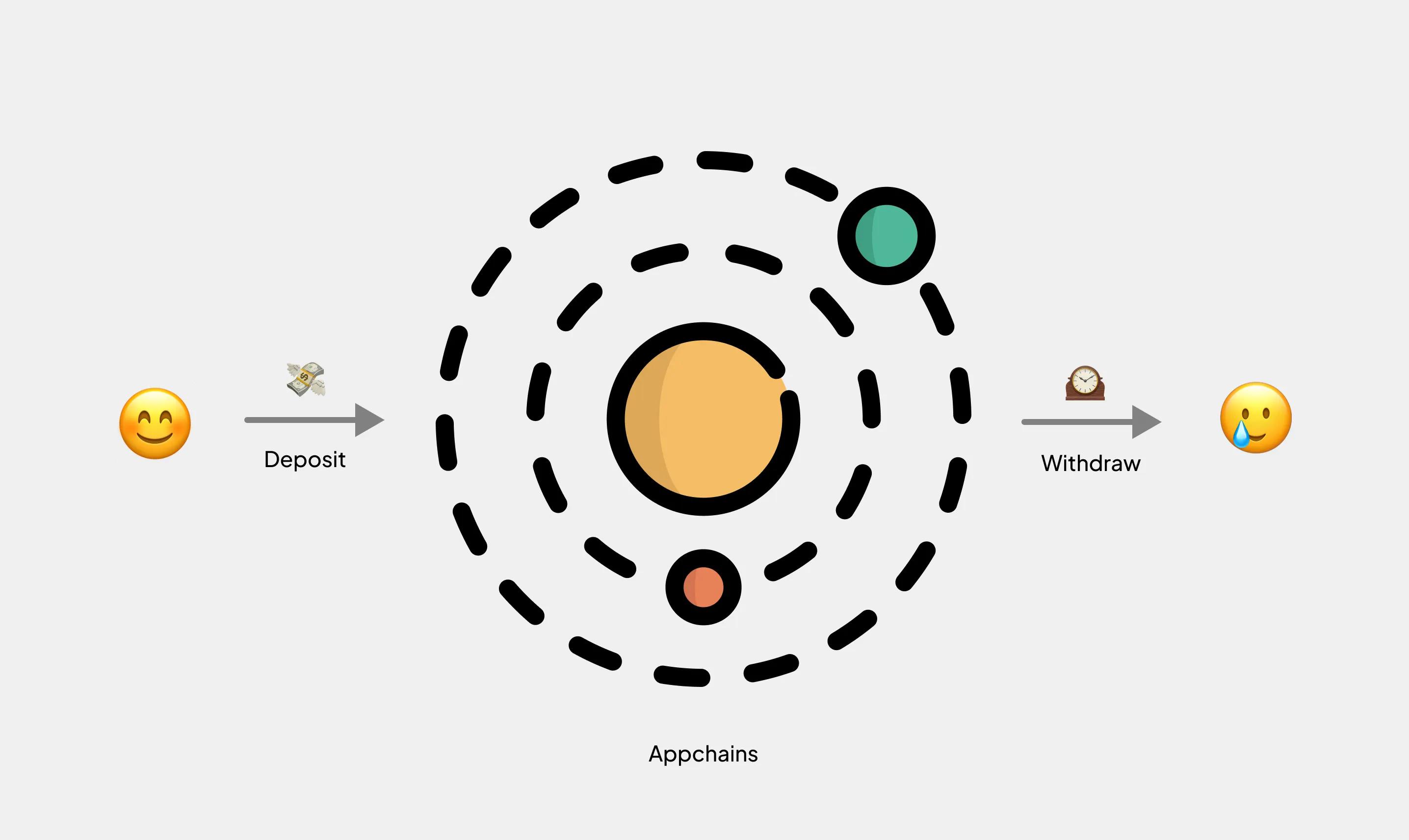
The Cartesi Rollup framework is application-specific, assigning each application its rollup app chain and CPU while linking its optimistic rollups' consensus directly to the base layer.

This guarantees that there is very little competition between apps for block-space. With the hard part of the logic being operated on the app-chain, this design avoids an overload and huge fees from the base layer.

This structure also ensures that validators can leverage the security features of the base layer, allowing any honest validator to enforce correct outcomes independently.

4. New Design Space: DeFi Applications Driven by Computation

Below are examples of applications that become more natural when complex, stateful, and numerical logic can be part of a verifiable workflow.

4.1 Risk Management as a First-Class Protocol Component

Some DeFi risk management today is relatively static. With complex computation, protocols can incorporate:

  • Scenario-based stress testing
  • Volatility-aware collateral requirements
  • Portfolio-level risk metrics
  • Dynamic parameter updates based on observed market behavior

Instead of relying on a few predefined thresholds, the protocol can periodically recompute system-wide risk indicators and adjust parameters accordingly. The risk engine itself becomes part of the protocol’s logic, rather than an off-chain advisory tool.

4.2 Prediction Markets with Dynamic Odds and Matching

Prediction markets often rely on simplified pricing mechanisms that are easy to compute. However, better execution environment allows for richer internal logic, such as:

  • Continuous aggregation of positions
  • Dynamic recomputation of implied probabilities
  • More sophisticated matching between participants
  • State-aware market closing logic

For example, a system could match opposing positions through a dedicated matching engine, recalculate odds based on total exposure and distribution of results without high gas fees and update market data continuously within epochs.

4.3 Long-Running DCA and Strategy Engines

In most simple on-chain DCA systems, purchases happen in fixed time intervals (e.g., once per day or week) and often at discrete price points when a transaction is triggered. That means you only average at those specific moments.

A stronger execution environment will allow for operations of minimal granularity, which means instead of discrete steps, the system can make purchases continuously, at extremely small intervals across both time and price, using streaming tokens

4.4 Credit Scoring and Behavioral Models

With access to more expressive computation, protocols can experiment with:

  • Behavioral scoring models
  • Statistical evaluation of user history
  • Risk tiers derived from multiple variables
  • Periodic recomputation of credit profiles

These models can remain transparent and reproducible, even if they are more complex than simple rule sets. The protocol’s decisions become tied to a defined model, rather than opaque discretionary processes.

5. Architectural Realities: Designing Computation-Driven DeFi Systems

Expanding the execution environment does not remove the need for careful system design. Instead, it shifts where complexity lives and makes certain architectural components explicit parts of the protocol.

Financial models depend on inputs like asset prices and external events like, user and market activity. As mentioned earlier, applications may not automatically have access to all base-layer. Instead, data must be introduced through well-defined channels.

If computation becomes a first-class element of DeFi, then data flow, input validation, and execution coordination become central design concerns.

A key reality is that expanding the execution model does not eliminate complexity, it relocates it. There is no silver bullet, but for some cases, the ones that depend on a rich execution environment, Cartesi is the best out there.

Subscribe to The Cartesi Newsletter

Join our newsletter to stay up to date on features and releases

More from Use Cases

Use Cases/Jan 27, 2026

Execution Layer Meets Data Availability: The Synergy of Linux Runtimes and High-Throughput DA

Explore the 2026 modular ecosystem where the Cartesi Machine handles the heavy lifting for high-compute dApps. By complementing EVM with a full Linux environment, builders are climbing the "Cone of Innovation" toward use cases like Decentralized AI and world simulators. Pairing this execution power with high-throughput DA solutions like Avail or Ethereum’s Pectra upgrade provides a stack that finally matches Web2 performance without sacrificing a decentralized ethos.

Written By Shaheen Ahmed & João Garcia

Use Cases/Oct 2, 2025

What’s Next for Social Appchains?

Web3 social apps are evolving fast, combining the familiarity of Web2 with the openness and decentralization of Web3. Cartesi appchains empower builders to create rich, complex social experiences, including collaborative content, AI-driven interactions, and gamified communities, while keeping everything secure and verifiable on-chain. Projects like Scribbl, where AI judges doodles in a decentralized and transparent way, show how Cartesi opens new possibilities for social apps and creative ecosystems.

Written By Shaheen Ahmed

Use Cases/Sep 25, 2025

Expressive and Secure DeFi Appchains with Cartesi

Appchains offer customizable, application-specific blockchains that solve high fees, slow transactions, and UX issues on shared networks like Ethereum. With Cartesi Rollups, developers can quickly deploy appchains anchored to Ethereum, benefiting from low costs, flexible governance, and robust fraud-proof security. While withdrawal delays exist, many DeFi applications, such as staking, yield farming, and reputation-based lending, naturally align with longer timelines, making optimistic rollups a practical and secure choice for building scalable, feature-rich apps.

Written By Shaheen Ahmed

© 2026 The Cartesi Foundation. All rights reserved.